Courage, loyalty, family in “Tigg and the bandicoot bushranger” by Jackie French
Rating: 4 .5 / 5
Recommended age range: 9-16 years
Warnings: none
Genre: Fiction stories for children – Adventure
“Tigg and the Bandicoot Bushranger” by Jackie French
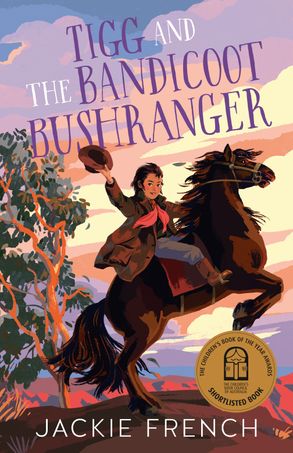
Jackie French, well-loved author, household name, Senior Australian of the year for 2015, OBE, and previous laureate of children’s books, has done it again by writing a book in which I learned a great deal about the role of the Chinese in early Australian history on the goldfields. I also enjoyed it simply as recreational reading.
This story has a bit of everything in it – adventure, mystery, a great plot and interesting characters. It would lend itself well to being made into a movie for the big screen. I can just imagine the currawongs and birds that are described so well in this book, the scenes of the Australian bush and the rollicking hills as background for the drama of the life of the main character, a young girl called Tigg.
Main character Tigg is a 12 year old orphan brought up by “Ma Murphy” who runs the ‘Pot ‘o Gold’ shanty supplying provisions to anyone heading to the Victorian goldfields.
Life in a rough shanty is not safe for a young girl or unmarried woman, and so Ma Murphy helps Tigg to disguise herself as a male bushranger.
Binding her chest to keep it flat and putting on a yellow straw wig with cabbage tree made hat, she is able to put on a deep-voice and Irish accent to imitate a young Irish man…but not for long because she is soon shot in the shoulder and must go into hiding.
To evade the troopers she then seeks the assistance of one Henry Lau from Hong Kong who hatches a plan to disguise her as one of the many Chinese miners walking the long walk from Robe in South Australia to Victoria.
As so often happens in life, Tigg changes her mind about who she is. Half out of necessity and half out of longing, she longs to just be herself – a girl.
“Suddenly she couldn’t resist. She’d been a boy for so long! What did a dress even feel like?
“She tied the ends of the tent together firmly, then peeled off her shirt and trousers, and then the bandages she had been wearing for two years now to keep her chest flat.”
“…she did very much want to be a girl, and not just because disguising was increasingly difficult. She’d love to try on bright silk dresses, like those she’d glimpsed on dancers passing the Pot ‘o Gold. It would be fun to let her long hair fall free except for a satin ribbon. A girl might one day be part of a family. She longed to have a family, people who cared about her and each other and had picnics or Christmas dinners together.”p.92
I learned a great deal about the role of the Chinese in early Australian history on by reading this book. I learned that the Chinese were innovative, clever, and entrepreneurial. They established market gardens and helped irrigate farms, selling their farm products to gold prospectors. Whilst there were racist attacks on them, at the same time they were widely respected in Australian society.
The Chinese were: “some of Australia’s most respected shopkeepers, lawyers, doctors and other professionals..” They were also extremely knowledgeable about irrigation techniques and were skilled in “…stonemasonry, well-digging and irrigation, as well as cooking and other arts.” p. 294
Notes at the end of the novel complement the story and reveal interesting paradoxes of history. For example, French shows 1850s Australian society was quite hierarchical and sectarian. Even though the majority of people were WASP (white Anglo-Saxon Protestant), French notes that: “..in many Australian counties people as white-skinned as the Roman Catholic Irish were still not counted in the census.” (p.298)

 Jane Allison reviews books