Why ‘The Friendly Snowflake’ Is a Must-Read for Children

Rating: 5/5

My description of this book in 10 words or less : A rare gem of a book!

For ages: 6-10 years and up

Genre: Junior Fiction, Fable

Warnings : none

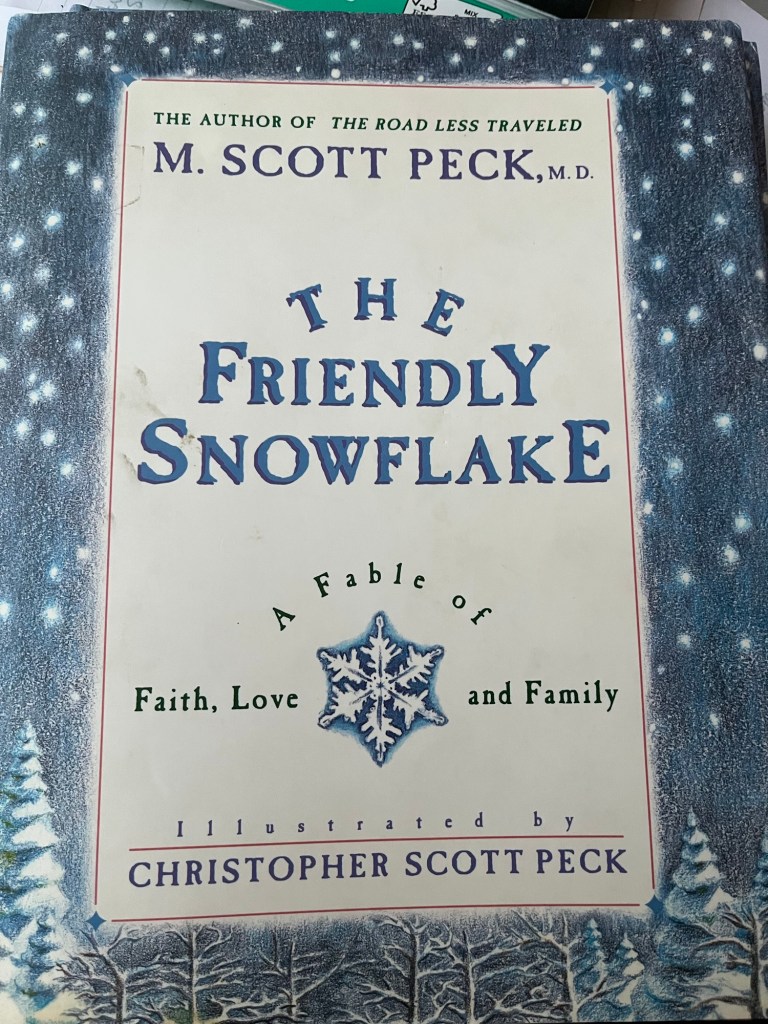
‘The Friendly Snowflake’ by M. Scott Peck is a fable for children about faith, love and family. When it was first published in 1992 it sold 155,000 copies. It is now out of print but I think it has a lot to offer. If you are a parent you may like to purchase a second-hand copy for your child online. The story is illustrated by M. Scott Peck’s son, Christopher Scott Peck.

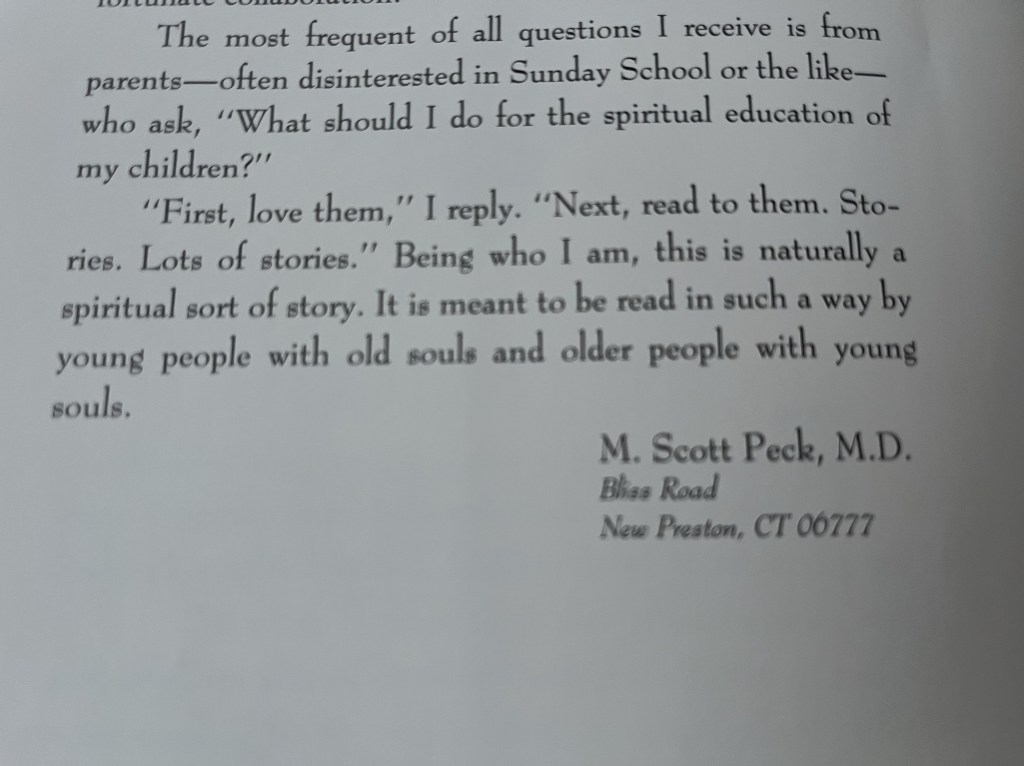
Parents wanted to know

The story : A young girl ruggs up and ventures out into the snow to play. Whilst enjoying the day a snow flake happens to falls on the tip of her nose.

She gives the snowflake the name “Harry” and sees it as ‘a friendly snowflake.’
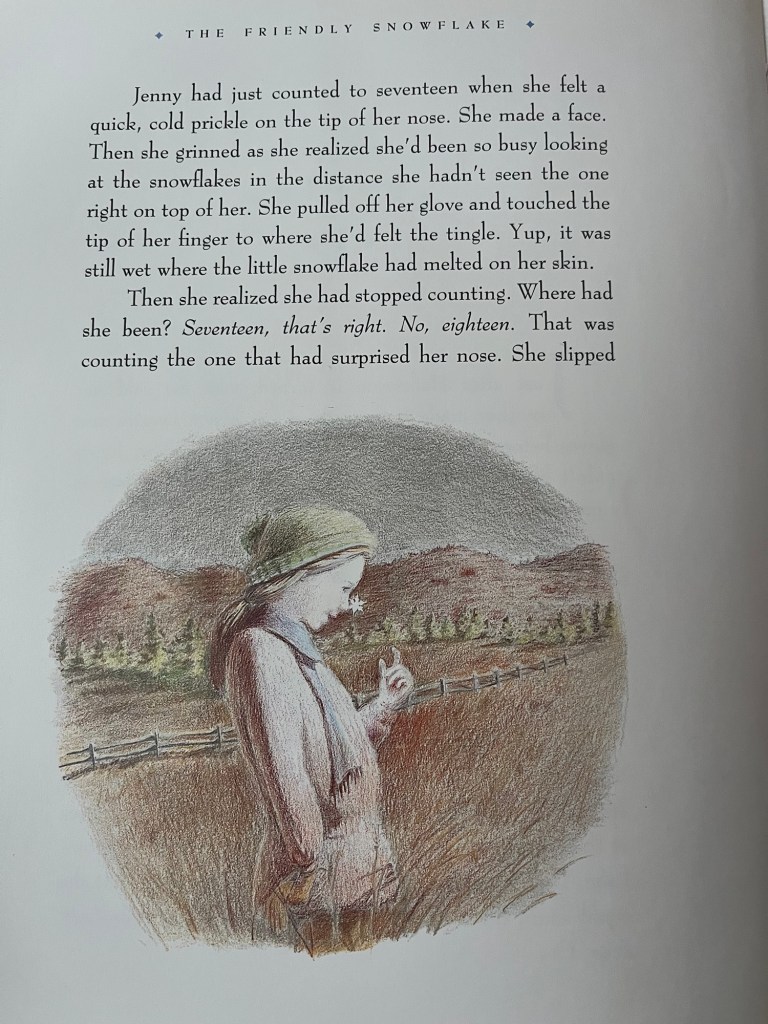
She counts the number of snowflakes that fell and, finding there were only a few, asks what were the chances of that particular snowflake falling just on her nose at that time :

“Since there were so few snowflakes, wasn’t it something that one of them had managed to find its way right to the tip of her nose …Why? Maybe it had wanted to meet her. Maybe it was a friendly snowflake.” (p.11)

“That’s silly”….said her brother. “Snowflakes aren’t friendly….They just land where they land. It was an accident…just a statistical happening.” (p.12)

Their Mother ends the first ‘discussion.’ hinting that neither child has enough evidence to go on to win the argument. So they leave that one go. However, the Mother says that it can be ‘very important sometimes to decide whether something’s an accident or whether there’s meaning behind it.” (p.13)

An interesting thought in a world that always seems to demand strictly factual cause and effect answers. The Mother’s statement sows the seed of thought for the rest of the story.

The girl’s brother is said to be interested in science due to his Father who is a good role model. Her brother is reasonable and debates his sister in a reasonable manner. Although he cannot see the value of her arguments, he opens a book and shows her what snowflakes look like under the microscope. He is willing to talk and debate even if he doesn’t at first agree.

The ongoing discussions about spirituality, the soul, snowflakes, serendipity and whether things happen for a reason or not make for a fascinating read.

Her brother showed her what a snowflake looks like under the magnifying glass.

What follows is a quite amazing series of debates between the children about whether the snowflakes clump together because they are ‘…related like a family’, or whether they ‘just happen to be next to each other in the air.’ Jenny persists with her argument that it is theoretically possible that the snowflakes are ‘related, like a family’.

She brings the debate to the fact she is close to her brother in the same living room and that is no ‘accident.’ However, her brother still doesn’t get her argument, and she privately regrets that anything he cannot explain he always seems to say is ‘an accident.’

A strength of the book is that it shows how to argue purposefully and rationally in support of things that are difficult to prove. It is a hopeful book which hints at the value of mystery and the fact that not everything can be explained.

For those readers who want to listen, there is much here to ponder on.
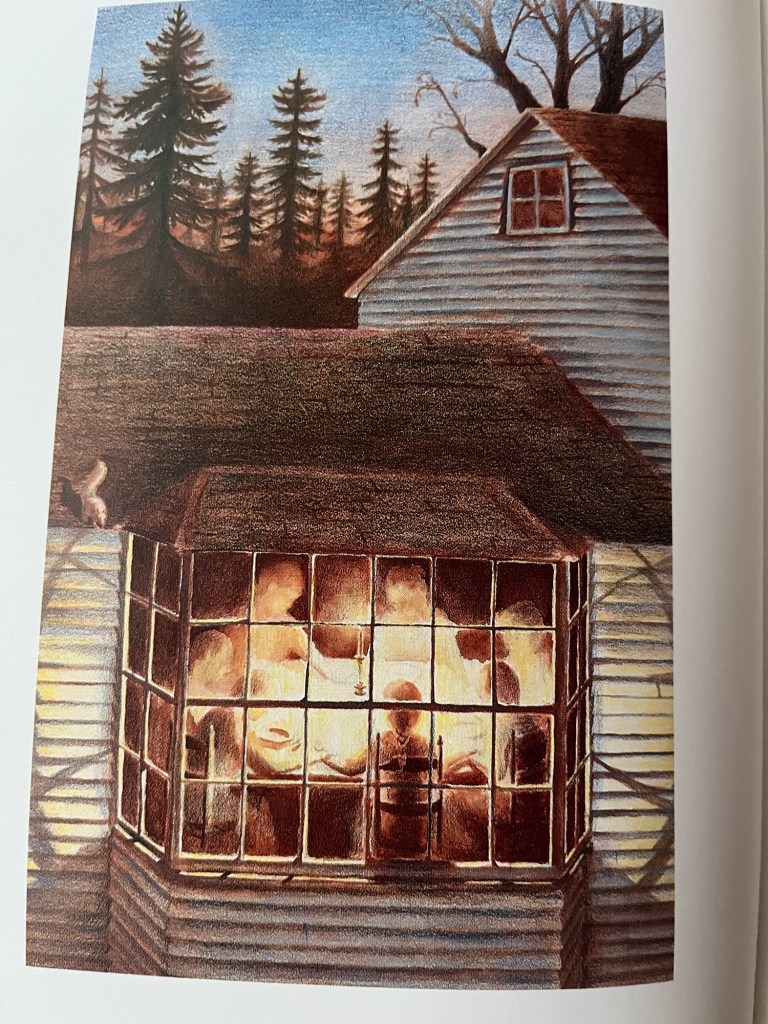
‘There’s lots and lots we can’t explain. The world is full of mystery.’ her Dad says. Jenny likes living in a world full of mystery. 

Here is one of my favourite quotes from the book:

“She wondered…God was certainly good to them. But did God actually love her? He -or She- was important and powerful. How could God possibly care for just one person, particularly for a person as small and ordinary as herself? But then she remembered Harry (the snowflake.). Harry had gone to the trouble to find her. Maybe God was like that. …maybe God could somehow be both in a giant storm and in a single little snowflake…” p.30
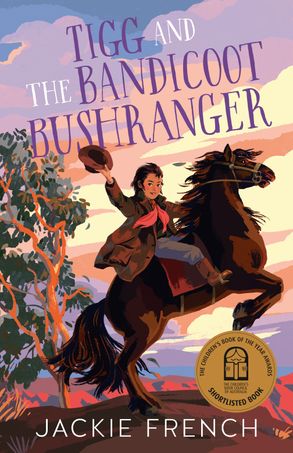
A notable shortlisted book for the Australian Children’s Book of the Year 2025

Courage, loyalty, family in “Tigg and the bandicoot bushranger” by Jackie French

Rating: 4 .5 / 5

Recommended age range: 9-16 years

Warnings: none

Genre: Fiction stories for children – Adventure

“Tigg and the Bandicoot Bushranger” by Jackie French

Jackie French, well-loved author, household name, Senior Australian of the year for 2015, OBE, and previous laureate of children’s books, has done it again by writing a book in which I learned a great deal about the role of the Chinese in early Australian history on the goldfields. I also enjoyed it simply as recreational reading.

This story has a bit of everything in it – adventure, mystery, a great plot and interesting characters. It would lend itself well to being made into a movie for the big screen. I can just imagine the currawongs and birds that are described so well in this book, the scenes of the Australian bush and the rollicking hills as background for the drama of the life of the main character, a young girl called Tigg.

Main character Tigg is a 12 year old orphan brought up by “Ma Murphy” who runs the ‘Pot ‘o Gold’ shanty supplying provisions to anyone heading to the Victorian goldfields.

Life in a rough shanty is not safe for a young girl or unmarried woman, and so Ma Murphy helps Tigg to disguise herself as a male bushranger.

Binding her chest to keep it flat and putting on a yellow straw wig with cabbage tree made hat, she is able to put on a deep-voice and Irish accent to imitate a young Irish man…but not for long because she is soon shot in the shoulder and must go into hiding.

To evade the troopers she then seeks the assistance of one Henry Lau from Hong Kong who hatches a plan to disguise her as one of the many Chinese miners walking the long walk from Robe in South Australia to Victoria.

As so often happens in life, Tigg changes her mind about who she is. Half out of necessity and half out of longing, she longs to just be herself – a girl.

“Suddenly she couldn’t resist. She’d been a boy for so long! What did a dress even feel like?

“She tied the ends of the tent together firmly, then peeled off her shirt and trousers, and then the bandages she had been wearing for two years now to keep her chest flat.”

“…she did very much want to be a girl, and not just because disguising was increasingly difficult. She’d love to try on bright silk dresses, like those she’d glimpsed on dancers passing the Pot ‘o Gold. It would be fun to let her long hair fall free except for a satin ribbon. A girl might one day be part of a family. She longed to have a family, people who cared about her and each other and had picnics or Christmas dinners together.”p.92

I learned a great deal about the role of the Chinese in early Australian history on by reading this book. I learned that the Chinese were innovative, clever, and entrepreneurial. They established market gardens and helped irrigate farms, selling their farm products to gold prospectors. Whilst there were racist attacks on them, at the same time they were widely respected in Australian society.

The Chinese were: “some of Australia’s most respected shopkeepers, lawyers, doctors and other professionals..” They were also extremely knowledgeable about irrigation techniques and were skilled in “…stonemasonry, well-digging and irrigation, as well as cooking and other arts.” p. 294

Notes at the end of the novel complement the story and reveal interesting paradoxes of history. For example, French shows 1850s Australian society was quite hierarchical and sectarian. Even though the majority of people were WASP (white Anglo-Saxon Protestant), French notes that: “..in many Australian counties people as white-skinned as the Roman Catholic Irish were still not counted in the census.” (p.298)

My name is Lizzie Flynn by Claire Saxby and Lizzy Newcomb

Based on the real life Rajah quilt made by convict women on board the Rajah whilst on their journey from England to Van Diemen’s Land (now “Tasmania”) in 1841.

The story spares nothing of the roughness and harsh conditions on board the convict ships. When a storm begins, ‘the hold becomes a groaning mass of writhing bodies, souped in a mix of vomit and filth.’ This book is not for the faint hearted, and as such is more suitable for upper primary, with explanations by an adult as to what is going on in the story.

One of the convict women, Molly, dies after having a fever. “They bury her in the heaving waters.” A Bible or religious book is shown in the illustration, with a Christian cross on the cover.

The main character becomes even more determined to not ‘pass from this world as if I had never been here.’ She works on the quilt, and when they arrive in Australia she is pleased that it will be a memento of the dying woman “Molly” and herself.

At the end of the book is some information about the Rajah quilt. It states that it was ‘lost for 147 years before being rediscovered in a Scottish attic.’

It is now housed in the National Gallery of Australia in Canberra.